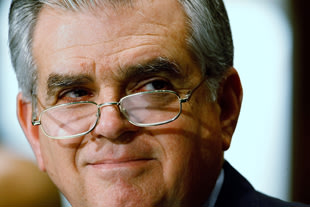
WASHINGTON ? Republican Chuck Hagel, President Barack Obama's nominee for defense secretary, is facing GOP critics who have challenged his past comments on Israel, Iran and nuclear weapons.
The former two-term senator from Nebraska is the lone witness at a Senate Armed Services Committee hearing Thursday that could be crucial in determining whether he will win Senate confirmation to succeed Defense Secretary Leon Panetta in Obama's second-term national security team. Two former committee chairmen ? Democrat Sam Nunn and Republican John Warner ? will introduce the nominee.
If confirmed, Hagel, a decorated Vietnam combat veteran, would be the first enlisted man and first Vietnam veteran to serve as defense secretary.
Hagel has the announced backing of about a dozen Democrats and the tacit support of dozens more who are unlikely to embarrass the president by defeating his Cabinet pick. One Republican ? Sen. Thad Cochran of Mississippi ? has said he will vote for his former colleague.
Six Republicans, including four members of the Armed Services panel, have said they will oppose Hagel's nomination. Sen. Jim Inhofe of Oklahoma, the top GOP lawmaker on the committee, has said he and Hagel are "too philosophically opposed" on issues such as defense spending, nuclear weapons and the Middle East.
Crucial for Hagel will be the questioning by Sen. John McCain, R-Ariz. Hagel and McCain are fellow Vietnam veterans who once had a close relationship during their years in the Senate, but politics and Hagel's opposition to increased troop numbers in Iraq divided the two men.
McCain has praised Hagel's military service but said he had serious concerns about positions the nominee has taken on various issues. He said he is reserving judgment until after the hearing. Sen. Lindsey Graham, R-S.C., earlier this month described Obama's selection as an "in-your-face" pick but was a bit less critical this week.
"Who are we getting ? the guy today or the guy who said things before?" Graham said Tuesday after a 20-minute meeting with Hagel. Graham said he doesn't doubt Hagel's "personal integrity, but I do have real concerns about his policy positions."
The hearing will be the first time Hagel publicly addresses the barrage of criticism that he is not sufficiently pro-Israel or tough enough on Iran. In the past, Hagel has questioned the efficacy of unilateral sanctions on Iran, arguing that penalties in conjunction with international partners made more sense. He has also been criticized for his comments about the influence of a "Jewish lobby" and his view of gay rights.
He addressed several of the issues in a 112-page questionnaire to the committee in which he said his wartime experience would shape his decisions about using military force.
"I understand what it is like to be a soldier in war," wrote Hagel. "I also understand what happens when there is poor morale and discipline among the troops and a lack of clear objectives, intelligence and command and control from Washington. I believe that experience will help me as secretary of defense to ensure we maintain the best fighting force in the world, protect our men and women in uniform and ensure that we are cautious and certain when contemplating the use of force."
In his responses, Hagel adopted a hard line on Iran and its possible pursuit of a nuclear weapon. He echoed Obama's view that all options are feasible to stop Tehran, praised the rounds of penalties and warned of "severe and growing consequences" if Iran balks at international demands.
Questioned about all options, Hagel said, "If confirmed, I will focus intently on ensuring that the U.S. military is in fact prepared for any contingency."
He said that he would continue to put in place the "smart, unprecedented and effective sanctions against the Iranian regime" that Congress and the Obama administration have adopted in recent years.
The criticism of Hagel has surprised some of Hagel's strongest backers.
"This idea that's being propagated that he might be soft on adversaries. Chuck Hagel's not soft on anybody, particularly himself," said Sen. Jack Reed, D-R.I., a member of the Armed Services Committee, in a conference call with Hagel allies. "He drives hard. He's someone who searches for the right approach and the right policy."
Copyright 2013 by The Associated Press. All rights reserved. This material may not be published, broadcast, rewritten or redistributed.
Source: http://www.wral.com/republican-hagel-faces-gop-critics-at-hearing/12046321/
Tilted Kilt Barbara Palvin Yahoo Fantasy Football Nick Foles Auguste Rodin Breaking Amish Indianapolis explosion

 effectively have improved their business significantly, according to 28 percent of organizations. Our research in 2013 will build on
  Our research finds only half (51%) of organizations are satisfied with their existing processes due to lack of skilled resources. More than half of organizations say analytics are too hard to build and maintain or data is not readily available. The most time-consuming aspects of the process are data-related ones, according to 44 percent of organizations. The technology too still has room to improve, with only 20 percent being very satisfied. The most critical capabilities are in the areas of predictive analytics (49%), visual discovery (48%) and taking action on the outcomes of the analytics (46%). We also found in
  The revolution in social media has expanded into business, bringing with it social collaboration and helping business processes by connecting people to achieve goals personally, departmentally or across an organization. This new technology was ranked the second most important technology in our research, but only 17 percent of organizations are very confident in their ability to use the technology well. With most organizations (86%) using shared folders and documents, it should be no surprise that part of the issue is related to technology. Organizations are evaluating new methods such as wall posting (45%), social recognition (41%), earning badges and awards (40%) and broadcast or Twitter-like capabilities (39%). With only a quarter of organizations being satisfied with their existing approaches, we see a lot of changes coming in 2013 in regards to the technologies selected and deployed. Our research in 2013 will examine where collaboration is critical in areas of human capital management, sales, customer engagement and even finance. Building on top of some groundbreaking research across business and vertical industries, we see business advancing rapidly with or without IT support, since business and social collaboration can be easily onboarded through the use of cloud computing. Unfortunately organizations are mixed in the methods they prefer to use to access collaboration ? embedded in applications, through Microsoft Office, embedded within tools like business intelligence or stand-alone ? making it complex to have consistency for users and their interactions. Using social collaboration with business analytics is a growing priority and organizations will need to assess their technologies to see if they meet this need. We believe that social collaboration will help bridge generational divides between workers as it becomes more easily accessible through web and mobile technologies, allowing managers and workers to engage anytime or anyplace. Focusing on the benefits of social collaboration, such as knowledge sharing, is critical as
  But beyond the simplicity for business and potential chaos for IT to eventually govern and support, the cloud computing environment is now a viable platform for IT to leverage in a multitude of methods, from IT infrastructure to developing and operating applications. The cloud computing environment can be used as a central point for integrating data and storing it for the enterprise or for customers and suppliers, but most organizations have not automated the integration of data to support business processes or business analytics and decision support. The lack of automation has increased concerns for data security, which 63 percent of organizations in
  workforce management research
 talent and track candidates into an organization. In 2012
  Organizations should explore resources in the company to determine if necessary skill sets exist, since their lack is the top barrier to adoption of technology according to 51 percent of organizations as